THE LOST ROAD A Search for the Soul of the West – Sean McGrath
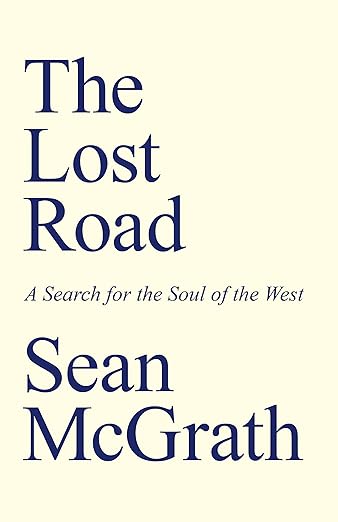
THE LOST ROAD A Search for the Soul of the West by Sean McGrath
Christian Alternative Books Winchester UK/Washington USA
ISBN 978 1 80341 273 3 £15.99
REVIEW by The Rev’d Hugh Valentine
Hugh Valentine is a priest in The Church of England. For more than three decades he sought to follow the model of the worker-priest, combining parish ministry with secular work in social work and social care, and was director of The Walcot Foundation until retirement. He maintains the website www.workerpriest.uk and lives in London.
Sean McGrath’s position is that the Christian West has lost familiarity with the mystical and contemplative sinews it once knew. The cost of this is a loss of depth, a depth that bestows resilience in the face of life’s exhausting and dehumanising demands. This loss, he claims, is in major part the cause of the consumerist malady that is now global. He says that it is the Christian West that has inadvertently brought that about.
His book mixes autobiography with observation, thought and intellectual exploration. He regards autobiographies (what happens to us) as necessary tools in making grounded sense of things, including ‘intellectual’ things. As a young man, the death by his own hand of a cousin he loved shook him and his world view, and sent him on a meaning-finding mission to the East, seeking the Buddha and his truth.
This was not an uncommon itinerary in the 1970s and 80s for certain Western young adults beginning to sense the emptiness of their own culture and its rhetoric. He backpacked here and there, wandered the Himalayas, lived the searcher’s life, observed, read and absorbed. Yet he returned empty handed, with a hunch that the meaning he sought should perhaps be looked for within his own Christian, western treasury. Except that he could not be sure the treasury contained any remaining treasure.
Questions of meaning and purpose preoccupied him, and the impetus owed much to his cousin’s suicide. He describes being pressed by a central question ‘why should I live?’. He sensed some great abyss and needed to map its contours and its meaning. He visited a community of Carmelite hermits in Nova Scotia. Expecting to stay for two weeks he stayed five years. It was profound in many ways and taught him much but turned out not to be a permanent home.
He was seeking ‘the road’ referred to in his title. He sensed this was to be found in his native tradition of Christianity. But the road – or at least reliable slip roads on to it – appeared lost and unsignposted. In short, he contends that Western Christianity lost its familiarity with the wisdom practice of mystical contemplative praxis. And this loss fostered consumerism; a mindset full of discontent, psychological and ecological harm and one which ‘the West’ propagated around the world, even to cultures (he cites as examples India, China and Japan) previously inoculated against such disease by their own historical religious cultures.
That struck me as a quite a charge, not unlike the other charges laid against the ‘West’ in recent times. It is tempting to defensively push back.
Sean McGrath says that at the Reformation, Christianity ‘undid’ itself and in various ways lost depth in its mystical and contemplative streams. I doubt we can reliably ever know the degree to which such practices infused the church and its sons and daughters in previous centuries, just as we can’t today. Such practices, by their very character, are not shouty practices. But we might acknowledge that the multitudinous distractions brought in via the Enlightenment, the industrial revolution and later by mass media make the conditions for mystical, contemplative engagement with God harder to experience, or even care about.
The author’s focus on consumerism helps uncover for the reader its spiritual nature. Usually understood as (simply) the problem of materialism, his claim is that it is a problem of a distorted spirituality arising from this loss of the mystical and contemplative. Consumerism, he says, is a misdirected response to spiritual undernourishment, and what is missing, he says, are those mystical resources.
I am drawn to this claim. But can we all be mystical contemplatives? And has ‘the Church’ somehow culpably failed to nourish us in these practices? What would the Western Christian tradition look like if such a tradition had been far more central in faith and action? Many of us will share Sean McGrath’s view of the modern consequences of the absence of such a disciplining anchor in our live. He describes the ‘fulfilment’ we seek in shopping, buying, owning; the drive to ‘upgrade’ ourselves as well as our iPhones; the buying of experiences as though they are simply goods; our frequent changing of ourselves, our clothes, our friends and even our lovers. He reminds us that deliberately seeking ‘fulfilment’ is amongst the biggest of cul-de-sacs. The alternative? He says stability, simplicity (of character and living patterns) and learning what it is to engage with ourselves and the world using mystical, contemplative dispositions.
The author does not write-off modernity entirely. He quips that modern dentistry is a positive development and, more seriously, that international law, human rights and social justice are all positive products of the Christian West, even if not understood as such by modern minds.
What is Christian mysticism? “My teacher William McNamara defined Christian mysticism as the art of being human. He said the contemplative is not a special kind of person. Rather everyone is a special kind of contemplative”. This suits me very well, being introverted and inwardly explorative long before I understood anything of Christian mysticism. But aren’t such dispositions a minority? Does the author hold out any hope? The Lost Road certainly has an elegiac flavour to it. And he is clear that no return from secularism to a rooted Christian culture and praxis is likely in the West. But he is not without hope. It is serious but non-triumphalist hope. The breakthrough to a reawakening of contemplative appreciation of others and our planetary home is not expected via the self-help industrial complex or esoteric retreats. More likely through tears, individually and collectively shed, one way or another.
I think this is a terrific book. It apparently took him decades to find a way of weaving autobiography with his academic interests in theology and philosophy. The result is neither cheery nor morbid. It is simply a deep and valuable reflection on how things stand, how we may have got here, and what part we might play in contributing to an improvement, all for God’s sake.
Hugh Valentine
Candlemas 2026