Book Review
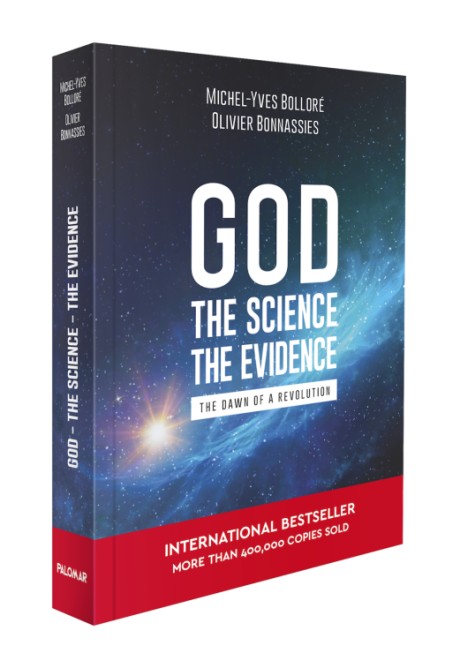
God, The Science, The Evidence
The Dawn of a Revolution
Michel-Yves Bolloré and Olivier Bonnassies

 Review by Adrian Hough
I have degrees in both Science (Chemistry) and Theology as well as a Doctorate (again in Chemistry). I am also a priest in the Church of England and over ten percent of the adult congregation at the Church where I now assist and worship are scientists or medical doctors. The appearance of a large book on Science and Theology was therefore of interest, especially as the cover states that it has sold more than 400,000 copies. I had also been intrigued by the full-page adverts for the book in The Church Times.
Before I begin the review proper, it is important to note that the book was written in French for a French readership and that the statement claiming sales of over 400,000 refers to the French edition with some 300,000 of these sales being in France itself. France is officially a secular society, albeit with a Roman Catholic background, and the French readership may well approach this book in a different way to those reading it in other languages and/or where there is a National Church. When reading the book, it is important to note that the authors use the term ‘materialist’ to denote someone who holds the belief that there is and can be no God. They also explain why they use the term ‘God’ (capitalised) rather than ‘a god’ which would be more in fitting with their stated aim.
– – – – –
This is a large book and it begins with statements from fifteen ‘International Personalities from all walks of life’ (each accompanied by a photograph) in which said personalities tell us that this is a very important and valuable book. I may be cynical, but their backgrounds and a reading between the lines did make me wonder how they had been selected and how many other possible statements had been excluded. This is followed by an introduction in which the authors state that they are not going to militate for a particular religion but rather to gather the most up-to-date rational arguments for the possible existence of a creator God. They then spend the first 333 pages doing just that. They begin by looking at the nature of evidence and knowledge in themselves and discuss what might constitute a proof. Here they distinguish between absolute proofs (such as those in logic and mathematics) and the relative proofs which apply to real life where our knowledge can never be perfect.
Following this introduction, the first part of the book (pages 61 to 333) contains a description and discussion of the evidence from the sciences. Here the authors focus heavily on the development of our understanding of cosmology and they conclude that the universe must have had a beginning (because of its thermal death) and that this implies the presence of a singularity (or singularities). This results in what became known as The Big Bang Theory. They then move on to discuss the fine tuning of the universe in what is usually termed the Anthropic Principle before dismissing the idea of multiple parallel universes seemingly because although these still require a singularity, they remove the need for the anthropic principle.
I don’t in any way disagree with most of the authors’ conclusions and the also provide a highly readable and even entertaining account of the developments that have taken place in our understanding of these subjects. However, the account is liberally sprinkled with tendentious adjectives, particularly those of a pejorative nature so that if someone, however, eminent, has a view with which the authors disagree, they are portrayed as being, in some way, dubious. These adjectives often serve to warn the reader that, in the opinion of the authors, the work of the person in question must be biased and rather than pursuing science for its own sake they will be trying to disprove the existence of, for example, a singularity, for ideological reasons. As an example, when the authors discuss the work of Stephen Hawking, he is variously described as a ‘famous materialist’ and ‘atheist Stephen Hawking’. They also take delight in repeatedly informing the reader that the term ‘Big Bang Theory’ was coined by the astronomer Fred Hoyle as a term of derision in his rejection of the concept that the universe began from a singularity.
There are also over fifty pages describing how Soviet and German Scientists (the latter under the Nazi regime) were persecuted and killed because their research was deemed to be anti-materialist. The purpose of the chapter is to demonstrate the lengths to which regimes will go to destroy evidence for God. This account, which is entitled ‘The Big Bang, A Noir Thriller’, fails to mention that in the Soviet Union the persecution was part of a pogrom which resulted in the death of over one million people and that in Nazi Germany it was part of the wider Holocaust and that many of the scientists concerned were Jewish.
The more detailed discussion of physics and cosmology is followed by a brief foray into Biology with a statistical proof that life could not have emerged by chance. This is followed by quotations from one hundred scientists which seem to support the authors’ premise and an examination of what scientists believe (or don’t believe) based on statistics. At this point the beliefs of Einstein and Gödel also receive chapters of their own.
With a book written in and initially for a French readership, it is not surprising that references to familiar English Language names in the field of science and theology are absent. However, what is notable, is that the authors make little if any reference to the fact that there is already a wide-ranging literature in the field covered by their book and that it contains most if not all of their arguments.
Page 335 sees the start of what is effectively part two of the book in which both science and the claim that the book is not about a particular religion are abandoned. Instead, there are a further two hundred pages about humanly inaccessible truths in The Bible, who Jesus might be, the refutation of alleged errors in The Bible, miracles, philosophical proofs, and refutations of materialist arguments that disprove the possibility of the existence of God. The authors’ refutations of objections to Jesus, criticism of the Biblical creation narratives and materialist arguments against God are mostly quite valid and they are presented in a very readable form but they are not what the authors stated that the book is about. There is also the strange claim that The Hebrews were very fortunate to possess the Bible as it guided them into having the only set of beliefs in the ancient world that are compatible with the modern worldview. The authors appear to be ignorant of the fact that the Hebrews’ worldview preceded the appearance of the various scrolls that constituted the Hebrew Scriptures and that these scrolls reflect the Hebrews’ pre-existent worldview rather than forming it. There is also a chapter which claims that further proof for the existence of God is provided by the success of the Jewish Faith and the continued existence of the State of Israel.
– – – – –
Putting aside the wide-spread use of tendentious adjectives, this book has several serious flaws. One of these is that it both implicitly and explicitly uses arguments which fall foul of the error of ‘God of The Gaps’, using phenomena which science has not explained to invoke an alternative explanation in the form of a deity. A second is that there appear to be unsupported logical leaps together with a seamless transition from physics to metaphysics. In particular, the authors confuse descriptions of the universe itself with its emergence (or creation) out of nothing and they make a category error in moving from the concept of a singularity to a deity of some sort. These are well-known errors in the field of science and theology but there seems to be no awareness of them.
The third flaw is that the two hundred or so pages or so which constitute the second part do not belong in this book. It is irrelevant both to the authors’ original claimed intent and to the title of the book. If the authors had stopped at page 333 and then, after their conclusions, included an appendix containing the refutations of materialist arguments against God together with refutations of so-called errors in The Bible, that would have been fair enough They could have noted that they had included this appendix as an example of the implications for their own religious views.
The book left me feeling that a potential opportunity had been wasted. The French Language edition of this book sold over 400,000 copies and it therefore clearly filled a gap in the market. The book is very readable, even racy, and it contains a decent summary of cosmology, why our current understanding is consistent with the existence of God and other scientific insights. However, its tendentious adjectives, biased wording and unnecessary chapters, transform what could have been quite a good book of half the length into an overly long book which, although good in parts, is deeply flawed and in some places quite bad. I really wish that the English edition had been rethought along these lines because, had this been the case, I would be recommending that everyone with any interest in religion should read it.
The wording on the back cover states that ‘God, the Science, the Evidence will surprise many readers’. I was not one of them, neither in the way the claim is intended nor in what I discovered when I read the book. I believe in a Creator God and I hold the opinion that the Big Bang describes how the universe began but the latter does not prove the former. At best it demonstrates what we already knew, namely that science does not disprove that there is a god (deliberate use of the lower case). This book is not the dawn of a revolution. It’s an over-dramatic presentation a change that has already happened. When I described the book to an Evangelical Christian with whom I was having coffee, his response was very telling. ‘But we’ve known all that for years.’
Adrian Hough – September 2026
The Rev’d Dr. Adrian Hough was born at the end of the 1950s and lives in the Parish of Pinhoe with Poltimore on the edge of Exeter where, although now retired’ he has ‘Permission to Officiate’ and generally helps as needed and requested. Adrian has degrees from Oxford University in both Chemistry and Theology, is a Member of the Royal Society of Chemistry (MRSC) and is an Associate of the Royal Photographic Society. Prior to ordination he constructed computational models of the chemistry of the global troposphere. Since 1992 he has served as a parish priest in Rural England and the Shetland Islands, as a Bishop’s Chaplain and as Diocesan Mission and Pastoral Secretary, the final two roles being within the Diocese of Exeter. He is the author of two theological books and several papers as well as his earlier publications in science.