HEALING THE WOUNDS OF HISTORY
THE DRESDEN STORY
Dr. Paul Oestreicher

In December 1940 Hitler’s Luftwaffe began to attack Britain.
Coventry was the especially chosen target. It remains iconic. Just under 1000 people died. The medieval city-centre was destroyed and with it the Cathedral of Saint Michael. Most of the industries survived. On Christmas Day, Dean Howard, preaching in the Cathedral ruins, declared: “We say no to revenge. When this conflict is over, we shall, with our present enemies try to build a kinder more Christlike world.” The Empire Service of the BBC relayed that around the globe. This is also where the Dresden Story begins.
Dresden, unlike Coventry, is not an industrial centre but a treasure house of European culture. Its 1743 Lutheran Baroque masterpiece, the Church of Our Lady, outclassed the more modest Catholic Cathedral. The capital city of the State of Saxony drew art and music lovers from around the world. Dresden’s suffering in war was to outclass Coventry’s. Not surprisingly, even in the midst of the East-West divide, the two cities in 1969 signed a treaty of friendship, became twin cities. I was in on the signing. The Cold War did not deter the two City Councils, nor their churches.
In the course of the War, Anglo-American military strategy outclassed the Luftwaffe’s bombing techniques. The blanket bombing of German and Japanese cities created firestorms that killed huge numbers of civilians. In Hamburg 40 000 were to die with 100 000 in Tokyo and a greater number, in the age of the atom, in Hiroshima and Nagasaki. There are comparable figures in nearly all of Germany’s cities, large and small.
This was widely accepted. It took the prophetic Bishop Bell of Chichester to challenge it in the House of Lords. That was enough to stop him from becoming Archbishop of Canterbury.
As the war drew to a close, with victory assured, it looked like Dresden would be safe – but not so. “Bomber Harris” had decided on a last throw.
The Dresden firestorm killed ‘only’ 25 000, many of them fleeing ahead of the advancing Soviet army. The majestic Frauenkirche did not receive a direct hit. It looked like surviving. However, the intense heat so destabilised the structure, that days later it collapsed into a great heap of stones. In the post-war years, that heap came to be venerated. People came there by candlelight to mourn the devastation of their city and the pity of war.
In 1989 the Berlin Wall was peacefully brought down by the people. Before long, the German Democratic Republic ceased to exist. The Dresdeners began to wonder, might their famed Cathedral be restored. The Peace Movement resisted the idea, as I did also. The stones meant too much. But it began to become clear, that is not what most people longed for.
In Britain, regretful voices were raised. Self critically, Churchill wrote in his history of the Second World War that Allied firebombing had been terrorism by some other name. After the Dresden raid, this looked more like the revenge that the Dean of Coventry had rejected long before.
Air Marshall Harris began to be blamed. Alone among his military equals, he was not given a peerage. Embittered, he emigrated to South Africa. His insulted fellow airmen raised the money to place a Harris statue in the Strand outside the RAF Church. Its Patron, the Queen Mother, did not attend its unveiling. A line was being drawn.
In Dresden it was now clear, the Frauenkirche was wanted. When the original building plans were discovered, still fully intact, a rebuild would surely be possible. The means must be found.
In England, Dr Alan Russell, as a British civil servant, gathered a group of influential citizens, creating the Dresden Trust to help find those means. He persuaded the Queen to approve of this plan. She chose to contribute personally. The Duke of Kent became the royal Patron. I was invited to represent Coventry Cathedral. My veneration of the memorial ruins had become untenable. My British identity committed me. Alan Russell impressively dedicated his life to the project. I shared with him the Cross of Merit of the Free State of Saxony. He died of cancer in 2019, having enjoyed the success of his Dresden Trust.
From the rubble, stone by stone, a replica of the old Frauenkirche began to become a reality. The brand new replica of the destroyed Frauenkirche became part of Coventry Cathedral’s Community of the Cross of Nails. That Coventry Cross is the only innovation on the altar of the new. A completely redesigned modern crypt has an altar designed by the London artist Anish Kapoor.
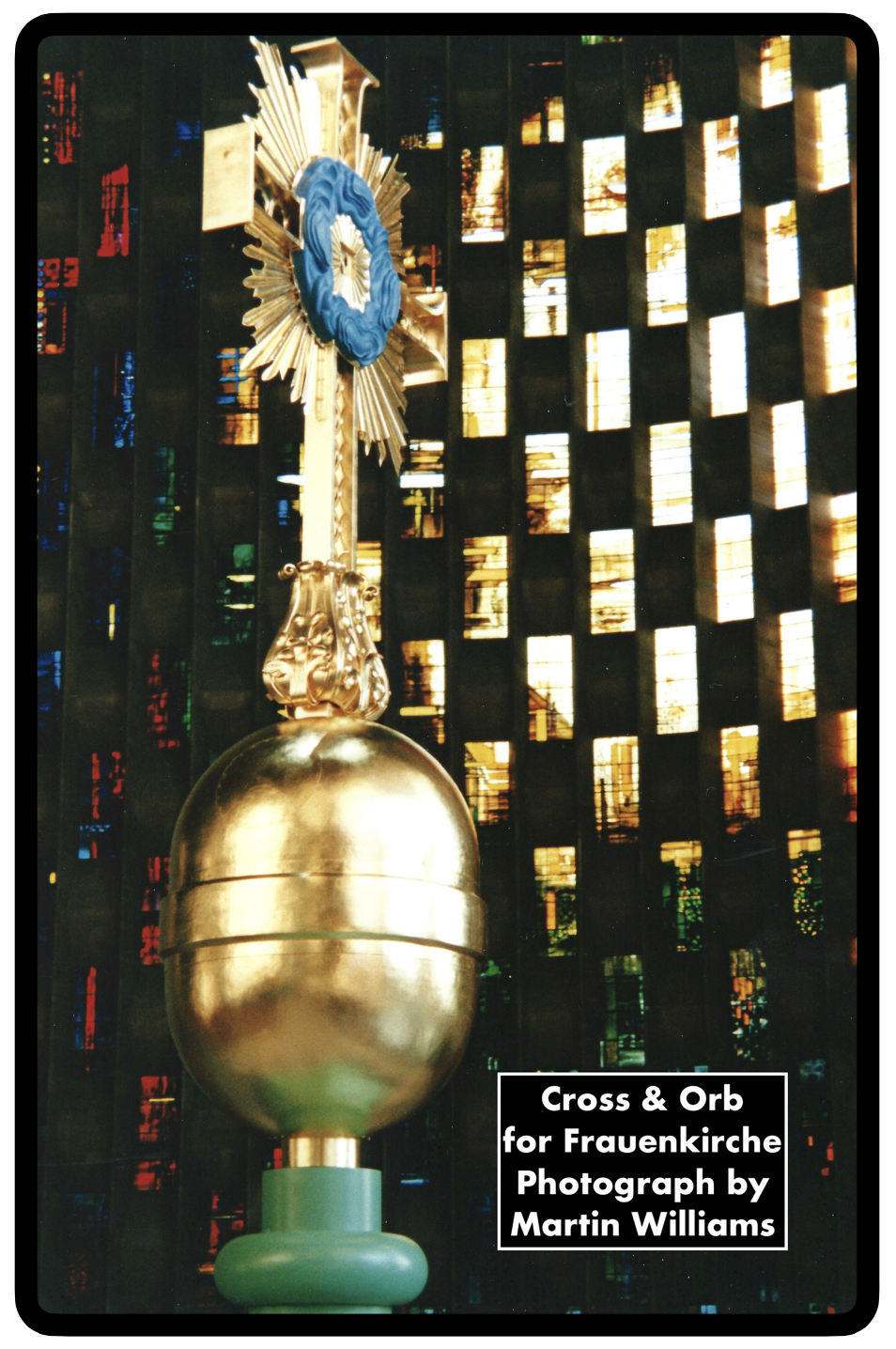
The Dresden Trust’s visible contribution provided the Crown of the Baroque Church of our Lady, made in a Southwark workshop by Alan Smith, a goldsmith whose father had piloted one of the Dresden bombers. This was hands on reconciliation. The golden crown toured the cathedrals of Britain before being flown to Dresden to top out the building at its reconsecration. Crowds cheered on October 30 2005 after eleven years of devoted work of the highest order. Some chose to regard this architectural and engineering feat a miracle. Not so. it was proof of what human skill and dedication can achieve.
MEMENTO is a literary record in German and English of the Frauenkirche’s story. In memory of the Wellington German-Jewish refugee architect and town planner Helmut Einhorn, this volume was presented to the Dean of the Victoria University of Wellington’s School of Architecture, jointly by the Embassy of the Federal Republic of Germany and the High Commission of the United Kingdom on July 30th, 2026.

Dr Paul Oestreicher – Canon Emeritus – Coventry Cathedral
Feast of the birth of St John Baptist, 2026