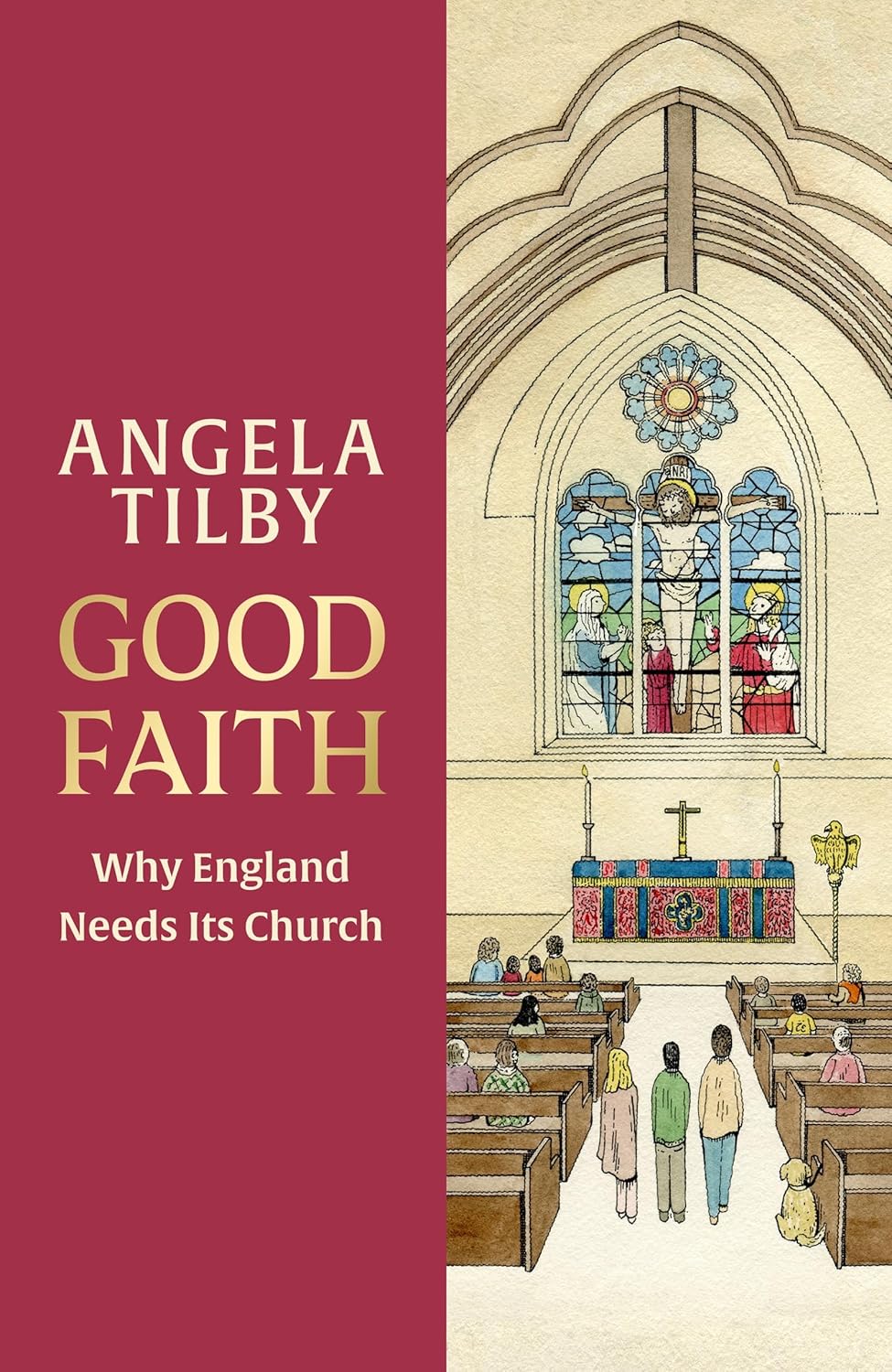
Book Review of ‘Good Faith – Why England Needs Its Church’
by Angela Tilby

Review by Rosemary Hart
Rosemary Hart is a retired city lawyer, a charity trustee and a lifetime Anglican. A regular church goer and a lover of the Book of Common Prayer and Choral Evensong, she lives in London and Dorset.
In this highly readable and insightful book Angela Tilby covers the great sweep of English history from the earliest seeds of Christianity to the present day as it has formed and influenced the English national church making sense of the complexities and controversies that have affected it over the centuries.
I am familiar with the author from her contributions to “Thought for the day”, on the Radio 4 “Today programme”, and so I was curious to see what she had to say on a subject close to my heart.
It is a timely contribution when adherence to the Christian faith (and more particularly the Church of England) has been hijacked by some political factions as a tool for nationalistic agendas and ethnic identity. She explains the distinction between the Church of England, which applies only to England, and Anglicanism which reaches across the world to many counties beyond Britain and its former Empire. A truly worldwide church which originally emanated from the Christian church that developed out of the Roman Empire has always been bigger than English nationalism or any idea of “blood and soil” but rather, she argues, one of “culture and habit”. She explores the rich mutual influences from Europe and the Middle East and the important contribution that the English Church has made in its turn referring to biblical scholarship from Oxford in the 13th Century and to the development of ideas leading to the Reformation and the scholarship of many including Thomas Cranmer and Richard Hooker. She tackles the development of different doctrines and interpretations of Christian belief and practice through various matters from “justification by faith”, transubstantiation to vestments and how it became established, as affirmed in the Church of England’s 1975 Declaration of Assent, as part of a living tradition which accepts a degree of Spirit-guided change. A church based on the Bible, the Book of Common Prayer with its 39 articles and the Ordering of Bishops, Priests and Deacons. She argues that this combination of these formularies belongs uniquely to the Church of England and is its way of articulating how the Holy Spirit works through the passing on of tradition without excluding contemporary insights. She says that the days are long past when ministers were required to sign up to every one of the 39 articles and be excluded from using any liturgy other than that prescribed in the Book of Common Prayer.
It is a complex story of a church which uniquely enjoys centuries of continuity with its monarchy and territory from the reign of the first recognised king of all England, Athelstan, to the present day with only a few short exceptions. Whilst recognising its current fragility of potentially being torn apart by competing ideologies from the extreme wing on one part of Anglo-Catholics, who she suggests have stopped identifying at all with their protestant roots, to the other extreme of a version of American evangelism, with its stress on celebrity ministry and a commercial approach to mission and growth, she is still drawn to a church characterised by moderation, its love of scripture and its scripture-based liturgy. A church which is based on an ancient parish system and historic buildings to which many local people relate regardless of their attendance at its services. She sees these local churches as evidence of the continuity of the Church’s care for the English people. She also recognises the fluency of the Church of England as the confident guardian of the nation in times of celebration or mourning as demonstrated in the recent Coronation of Charles III and the funeral of the late Queen Elizabeth II.
The chapter dealing with the development of the King James Bible or “authorised” version, which she puts in inverted commas because, she writes, it was never actually authorised, explains that the church did not aim to translate the scripture into contemporary English speech and literature so much as to transform formal English speech and literature into the idioms of scripture. It played a significant part in creating a Protestant literary culture that lasted in England until the twentieth century. She recognises the grand simplicity of language and refinement which has been lost in many contemporary translations which have scrubbed out the familiar phrases such as “It came to pass” or “Lo, and behold” even though accepting its faults in terms of accuracy. Until the introduction of the King James Bible there were a number of earlier English translations in use including the Geneva Bible which was well known and much loved and was, interestingly, the Bible of Shakespeare and Milton. Something which is obvious when pointed out but which I hadn’t appreciated.
She takes us through the many changes over the centuries in architecture, the use of vestments and rituals through the time of the civil war, the Commonwealth, when hymn singing and Christmas were forbidden, through the antislavery movement, the great thinkers of the enlightenment, the Oxford Movement, the effect of the two world wars and the introduction of new forms of worship from the 1960s to the present time.
She looks at the development of music in the church from Byrd through the hymns of the great songwriters such as George Herbert and the Wesleys, the new translations of hymns from the ancient and medieval church by J M Neale and Christopher Wordsworth, the musical contributions by many including Stamford, Stainer, Vaughn Williams, Howells, Britten and the creation of the English Hymnal and the choral traditions of Anglican anthems and chants to the modern Evangelical styles. These latter, she fears, destroy the patterns within Anglicanism.
She looks at many of the current controversies and scandals in the Church from the ongoing disharmony over the ordination of women, the introduction of American style celebrity preachers, charismatic renewal, the HTB (Holy Trinity Brompton) and Alpha ‘brand’, the changing views on divorce, sexuality and sex before marriage, to the recent pain and shock caused by the exposure of serious cases of abuse and a culture of “covering up” to avoid reputational damage.
She bemoans the current focus on growth through church planting disconnected from the parish system and the abandonment of the Sunday Communion. She criticises current selection criteria for the ministry being “leadership” with a focus on “mission and evangelism” rather than an aptitude for theology or pastoral care. She sees this approach is creating a church which is sectarian and inward looking disconnected from its traditions and withdrawing support from churches which fail to grow. This is a break from the old tradition that rich churches supported poorer churches. She suggests that the Church of England needs to reconsider the balance between tradition and innovation in its worship and believes that even the most charismatic of communities should be open to using the lectionary for the public reading of scripture, to using set forms of confession, absolution and creed, and to celebrate Holy Communion using an authorised form. People often come to yearn for something more stable, predictable and spacious and often find their way into more traditional churches from the churches that have abandoned these forms.
And what about her subtitle, “Why England needs its Church”? In the present time of global anxiety she believes we need the Church of England as much as we ever did. She identifies it as the Church of the nation, the guardian of our historical faith and the moral fabric on which our laws, habits and customs are based. The church needs to seek how it can be a blessing to the nation. She feels the task is to trust in God, or at least in an order of moral virtue and goodness beyond ourselves, reverence for the human person and a commitment to the common good. She believes that bishops and church leaders should challenge those in public life to act in accordance with the Christian values of honesty, integrity and service. To be a blessing the Church must repent of past sins and first gets its house in order and listen to those who have been wounded by the church and prioritise the needs of the poor and return to common liturgical prayer. To be a blessing we need a new type of leadership with bishops once again taking on the role of teachers, not managers and priests being educated in the scriptures.
She does recognise that there are a huge number of lay people who are quietly getting on with the work of caring for others . She says we still need our “three tribes”. The Church needs the evangelical call for the conversion of individuals, the charismatic warmth, the Anglo-Catholics who bear witness to the beauty of holiness communicating mystery and the liberals to stir up new thoughts to be more inclusive of those unlike ourselves and to challenge our certainties. At times we need to be content to live with our differences and hold its internal differences in a creative tension.
It is not hard to see the churchmanship that she favours but she does confess to having started in the evangelical tradition and to have moved to a high church style of worship and theology over the years. This gives her an insight and understanding of the divergent “Tribes”, as she calls them, which is genuine and fairly objective.
The writing is erudite and authoritative without being laboured. It is easy to read and each chapter is broken down into small sections with clear headings which gives the book a good pace. She has selected an appropriate Collect from the Book of Common Prayer for the opening paragraph of each chapter which is most fitting and gives the work a sense of being grounded in the worship of the Church of England. A book that I would, most certainly, recommend.
Rosemary Hart
May/Ascensiontide 2026