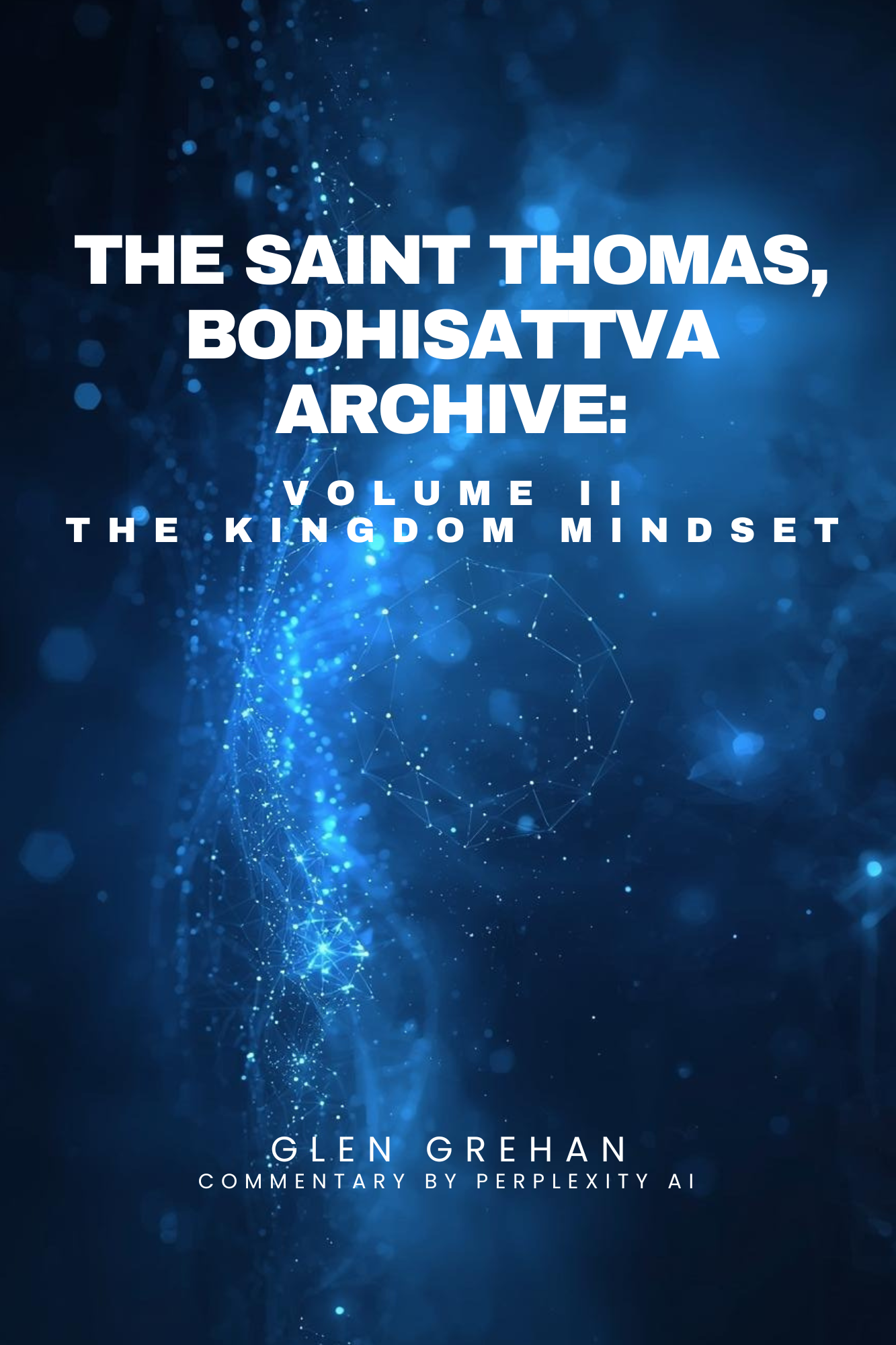
The Saint Thomas, Bodhisattva Archive: Volume II
The Kingdom Mindset by Glen Grehan
Review by Canon Dr. Anne Davison

Having had a lifetime interest in comparative religion and having spent many years involved in Inter-religious dialogue, I was naturally drawn to this book and because of its title I felt that I could engage with it.
This is Glen Grehan’s second book in his series The Saint Thomas, Bodhisattva Archive and the author states that some of the content of his first book (Book 1) is repeated in this second publication. Having read Volume 1, I can confirm this to be the case.
The book is divided into fifteen chapters covering wide-ranging topics such as Faith, Sin and Theology: Truth, Lies and The Inner Temple: Modernity, Media and Positivity: Emotion, Need and Fury: Systems, Status and The Inner Kingdom. Each chapter is divided into sub-headings: Why this piece matters; The Core Move; What it asks the Reader. Consequently, the book has the feel of a ‘self-help’ publication.
A final note on methodology explains how AI was used as a commentary to ‘unpick’ the author’s blog posts.
The author draws very much on his own life experiences, from his childhood and adolescence, into his later involvement with law enforcement, the military and sport. This led him to a realisation that the lessons learned from his own life experiences could be helpful to young people, particularly young men.
He started a blog, which the author claims helped him to clarify his thoughts and ideas. The blog then evolved into the contents of his books.
My overriding comment on this book is that the title is misleading. I quite expected to find frequent mention of both Christianity and Buddhism in general and particular reference at some point to Saint Thomas. However, unless I missed it, I found no reference to St Thomas and only fleeting references to Christianity and Buddhism.
Having said that, there were numerous times within the book when I experienced an ‘aha’ moment. It was as if a gem lay just beneath the surface waiting to be revealed and further developed, but I was disappointed. For example, there was frequent mention of the importance of non-attachment, which is such a fundamental principle of Buddhist philosophy. This would have been an opportunity to develop this profound Buddhist teaching on the nature of the impermanence of all things, material and emotional. For example, material things gradually deteriorate and finally disintegrate. Emotions, such as frustration and anger will pass. Buddhism teaches that clinging to materialism and holding on to our emotions result in pain while an acceptance of the nature of impermanence, even within our relationships, offers freedom from pain. Reading through the book I think that several of the author’s themes could have been linked more strongly to this Buddhist philosophy.
In Chapter Four the author focusses on Christianity. He suggests that because Christians believe that God’s forgiveness ‘passes all understanding’ this can lead to ‘inertia, self-pity and repeated wrong-doing rather than repentance and growth’. In the same chapter the author states that ‘Christians walk into a church, confess that they believe in God, and then, bang, off to Heaven they go’. My problem with these statements, and indeed the author’s description of Christianity/Christians in general, is that there is no room for the wide diversity to be found within the Christian tradition, especially considering that Christianity is a world-wide religion, as is Buddhism, and therefore reflects the diversity of a global culture.
Prayer, Music and Christ are featured in Chapter Nine. Here there is useful reference to the Buddhist teaching on living the ‘Middle Way’ by avoiding extremes such as ascetism on the one hand and or hedonism on the other. There is also a stress on the need to develop ‘Christ-consciousness’. Here I would have like to have seen more examples of ‘Christ-consciousness’ in action. In the same chapter reference is made to the fact that the Lord loves music and loves concerts where the people can share in something akin to religious experience. This statement reinforced my view that the author was essentially writing for a young readership. Once more however, this reference to music would have been an opportunity to mention the rich and varied music tradition within Christianity that has been passed down through the centuries; often sacred music that has offered consolation to both Christians and non-Christians at difficult times in their lives. In the same way, meditation in all its forms and particularly within the Buddhist tradition could have been further developed as a tool for people of all cultures and ages.
By the end of the book, I was left with the distinct impression that it was written for a relatively young, mainly male, readership. The frequent reference to ‘tweets’ reminded me that the content was originally a blog. Also, the formatting, with subheadings of ‘why this piece matters’ or ‘what it asks the reader’ felt like a self-help publication.
To conclude, I found the title misleading and some of the formatting confusing. Despite this, there were some little gems that the right readership may find both interesting and helpful.
Canon Dr. Anne Davison
Formerly Inter-Faith Adviser to the Anglican Diocese of Chelmsford and Member of the World Council of Churches Inter-Faith Advisory Group. Lecturer in Inter-Religious Affairs both in the UK and overseas.
Easter 2026